
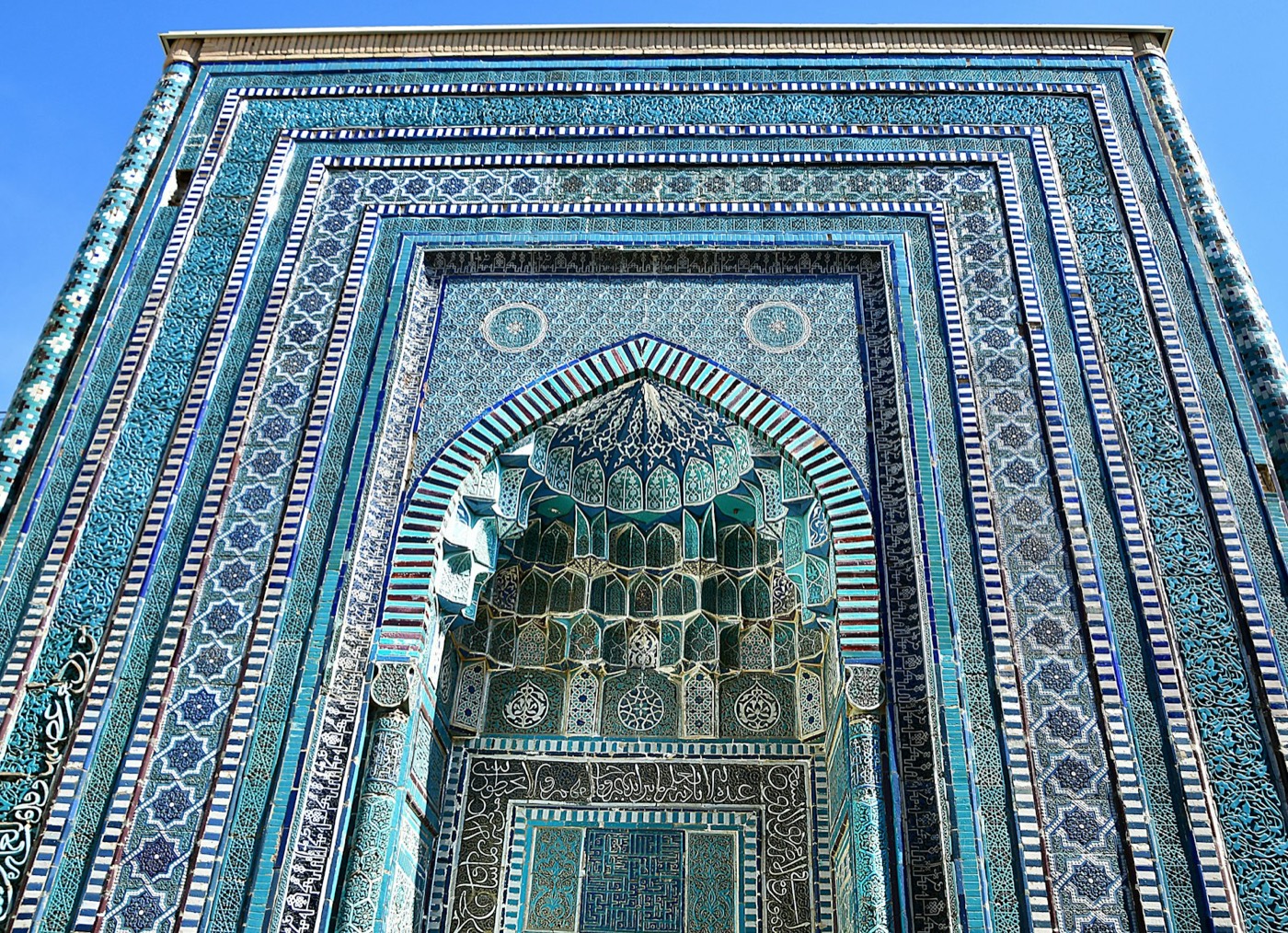
Timurid tile at its 14th-century peak — Shah-i-Zinda, Samarkand.
A mausoleum portal at Shah-i-Zinda — Timurid tilework at its 14th-century height.
The name that never changed
The name Samarkand is one of the oldest continuously-used place names in the world. It appears in Greek sources as Marakanda (Μαράκανδα) — Arrian's spelling in his account of Alexander the Great's Sogdian campaign of 329 BCE[3][14]. The underlying Sogdian form was Smarakanda, and virtually every etymology proposed for it dissolves the name into two Iranian roots: smara (stone / rock) and kanda (fortress / town) — 'the stone town' — or samar (meeting, gathering) and kanda — 'the meeting place'. Either way, the name is Iranian, coined by the Sogdian-speaking inhabitants of the oasis a good five hundred years before any Turkic-speaking peoples arrived[3][4].
Islamic-era Arabic and Persian sources render it Samarqand. The modern Uzbek Latin spelling Samarqand and the English Samarkand both descend from that Arabo-Persian form. In Russian it is Самарканд (Samarkand), in Tajik Самарқанд, and in Chinese travel accounts of the Tang dynasty 康國 (Kāngguó) — the last a reminder that Samarkand was a Chinese Silk Road destination long before it was a Russian one[4].
Afrasiyab: the city under the city
The Samarkand you visit today is not the original Samarkand. The pre-Mongol city — occupied for eighteen centuries continuously — stood on a mound called Afrasiyab, a 220-hectare plateau just north-east of the modern town[3]. Excavations by Russian and Uzbek archaeologists since the 1880s have found evidence of urban settlement here from at least the 8th century BCE, and possibly earlier.
Afrasiyab was successively the capital of Achaemenid Sogdiana (6th–4th c. BCE), the seat of a Hellenistic satrapy after Alexander, the biggest city of the Sogdian Confederation (5th–8th c. CE), and an Islamic metropolis of the Umayyad, Abbasid, and Samanid periods. The Ambassadors' Fresco, a mural from the second half of the 7th century found on the site's palatial quarter, is one of the most important surviving representations of Silk Road diplomacy — showing ambassadors from Tang China, Korea, Persia, and India in a single frame[3].
In 1220 the Mongols levelled Afrasiyab and its inhabitants; only a handful of families are recorded as returning. The site never repopulated. When the city was rebuilt, it was rebuilt several kilometres to the south-west — the pattern of the modern town. Afrasiyab today is a grassy archaeological reserve with a small museum housing the Ambassadors' Fresco and the pottery of the Sogdian city.
Alexander at Marakanda (329 BCE)
Alexander the Great reached Sogdiana in the summer of 329 BCE. Arrian's Anabasis records that he captured Marakanda in a hard-fought campaign, then spent much of the following winter subduing the Sogdian rebels who kept retaking it — this was among the toughest phases of his entire Asian expedition[14]. He built a Greek garrison and made the city his forward operating base for the war against the Sogdian rebel Spitamenes.
It was here, at Marakanda, that Alexander married the Sogdian princess Roxana (Roshanak, 'little star') in 327 BCE — a marriage often described in later sources as strategic (uniting Greek and Sogdian aristocracies) and a genuine attachment. Alexander's often-quoted line 'everything I have heard about Marakanda is true, except that it is more beautiful than I imagined' is not in Arrian and is likely apocryphal[14], but it circulates in every guidebook for a reason: the sight of the city from the north still stops travellers cold.
The Islamic Golden Age and the invention of paper (712–999)
Arab forces under Qutayba ibn Muslim captured Samarkand in 712 CE. Within a century it had become one of the great cities of the eastern Islamic world — a centre of Muslim scholarship, commerce, and, crucially, papermaking.
The Samarkand paper mill is one of the most consequential factories in world history. Founded in the aftermath of the Battle of Talas in 751 CE — at which Chinese prisoners of war (some of them papermakers) fell into Abbasid hands — the mill introduced mulberry-fibre papermaking to the Islamic world for the first time[12]. Within fifty years Samarkand paper was being shipped to Baghdad, then Cairo, then Fez, then Al-Andalus. The Samanid dynasty (819–999), which made Bukhara its capital but drew heavily on Samarkand's craftsmen, ran the golden age of this Islamic paper economy[13]. Al-Bukhari compiled his Sahih hadith collection just up the road; Ibn Sina (Avicenna) was writing his Canon of Medicine on Samarkand paper a century later.
The Konigil village outside modern Samarkand still produces silk-fibre paper by the Samanid-era method — probably the last working example of this specific process in the world[21].
Genghis Khan and the death of Afrasiyab (1220)
Samarkand's golden age ended in a single spring. In March 1220, Genghis Khan's Mongol army arrived on the outskirts. The city — then ruled by the Khwarezmshah Muhammad II — had one of the strongest garrisons in the Islamic world (some sources give 100,000 men). It fell in five days[16]. The Mongols massacred an estimated 30,000 defenders; scholars and craftsmen were spared, deported to work for the Khan.
Afrasiyab itself was systematically destroyed: walls torn down, irrigation canals broken, houses fired. Contemporary Islamic historians (Juvayni, Ibn al-Athir) describe the aftermath in terms usually reserved for the Book of Revelation. The city never returned to the Afrasiyab site. When Samarkand was rebuilt in the following decades, the new city rose a few kilometres to the south-west, where it stands today.
This is why the Samarkand tourists see is emphatically not an ancient city on its own foundations — it is a mostly-14th-century imperial capital rebuilt from scratch, next to the ruins of its ancient predecessor.
Timur's imperial capital (1370–1405)
In 1370 Timur (Tamerlane) made Samarkand his imperial capital and set about turning it into the most magnificent city in the world[6]. Over the following thirty-five years — much of it while he was campaigning across Persia, India, the Caucasus, and Anatolia — the city received the buildings that make it what it is today.
Timur's method was straightforward: whenever he conquered a city with skilled craftsmen (Damascus, Isfahan, Delhi, Baghdad, Tabriz), he had the craftsmen — masons, tile-cutters, calligraphers, gilders, silk-weavers — deported to Samarkand. Ruy Gonzáles de Clavijo, a Castilian ambassador who arrived in 1404, describes a city site that seemed to be under continuous construction by an army of imported artisans working in a dozen different regional styles[6]. This is why Samarkand's Timurid monuments have a distinctive stylistic hybridity: Persian arches, Indian carved marble, Damascene metal, Central Asian tile mosaic.
The three great Timurid monuments finished in his lifetime were the massive Bibi-Khanym mosque (1399–1404) — one of the largest mosques ever built in the Islamic world when it was finished; the Gur-e-Amir mausoleum (1404), originally built for his grandson Muhammad Sultan and later the burial place of Timur himself; and the extended Shah-i-Zinda necropolis, which received its most ornate additions in the Timurid period. Timur's own grandson Ulugh Beg (r. 1409–1449) would carry the project forward — building the first madrasa of the Registan (1417–1420) and, most spectacularly, the great astronomical observatory north of the city (1424–1429)[5].
The Registan: three madrasas, three centuries
The word Registan is Persian for 'sandy place' — a reminder that this was originally an open, unbuilt square on the outskirts of medieval Samarkand, used as a public gathering-place, market, and site of royal proclamations[8]. Its transformation into the tri-madrasa ensemble now on every Samarkand postcard took over two hundred years and three separate rulers.
The Ulugh Beg Madrasa on the west side (1417–1420) is the earliest of the three. Ulugh Beg, Timur's grandson and himself one of the great astronomers of the medieval world, endowed it as a leading centre of exact sciences. Its portal is inscribed with a Timurid maxim: 'The pursuit of knowledge is the duty of every Muslim, man or woman.'[5][8]
Two centuries later, the Shaybanid emir Yalangtush Bahadur commissioned the Sher-Dor Madrasa (1619–1636) on the east side, mirroring Ulugh Beg's building. It is famous for a striking figurative feature: two tigers (or lions) chasing white does across its portal, with human-faced suns rising over their backs[8]. Figurative animals — much less humans — are highly unusual in Sunni Islamic architecture, and the Sher-Dor is one of very few working religious buildings anywhere in the Islamic world to display them. The Persian-Uzbek Shaybanids' relatively liberal aesthetic patronage made it possible.
Yalangtush Bahadur then commissioned the third and central building, the Tilya-Kori Madrasa (1646–1660), which functioned as both madrasa and congregational mosque[8]. Its name means 'gilded' — an understatement for the interior of its prayer hall, which is entirely covered in gold-leaf muqarnas and painted Kufic inscriptions. Most tourists visit the courtyard and miss the prayer-hall entrance; the interior is the single most sumptuous room in Central Asian architecture.
Lord Curzon, later British Viceroy of India, visited in 1889 and famously described the Registan as 'the noblest public square in the world'[15]. A hundred and thirty-five years later, the description still holds.
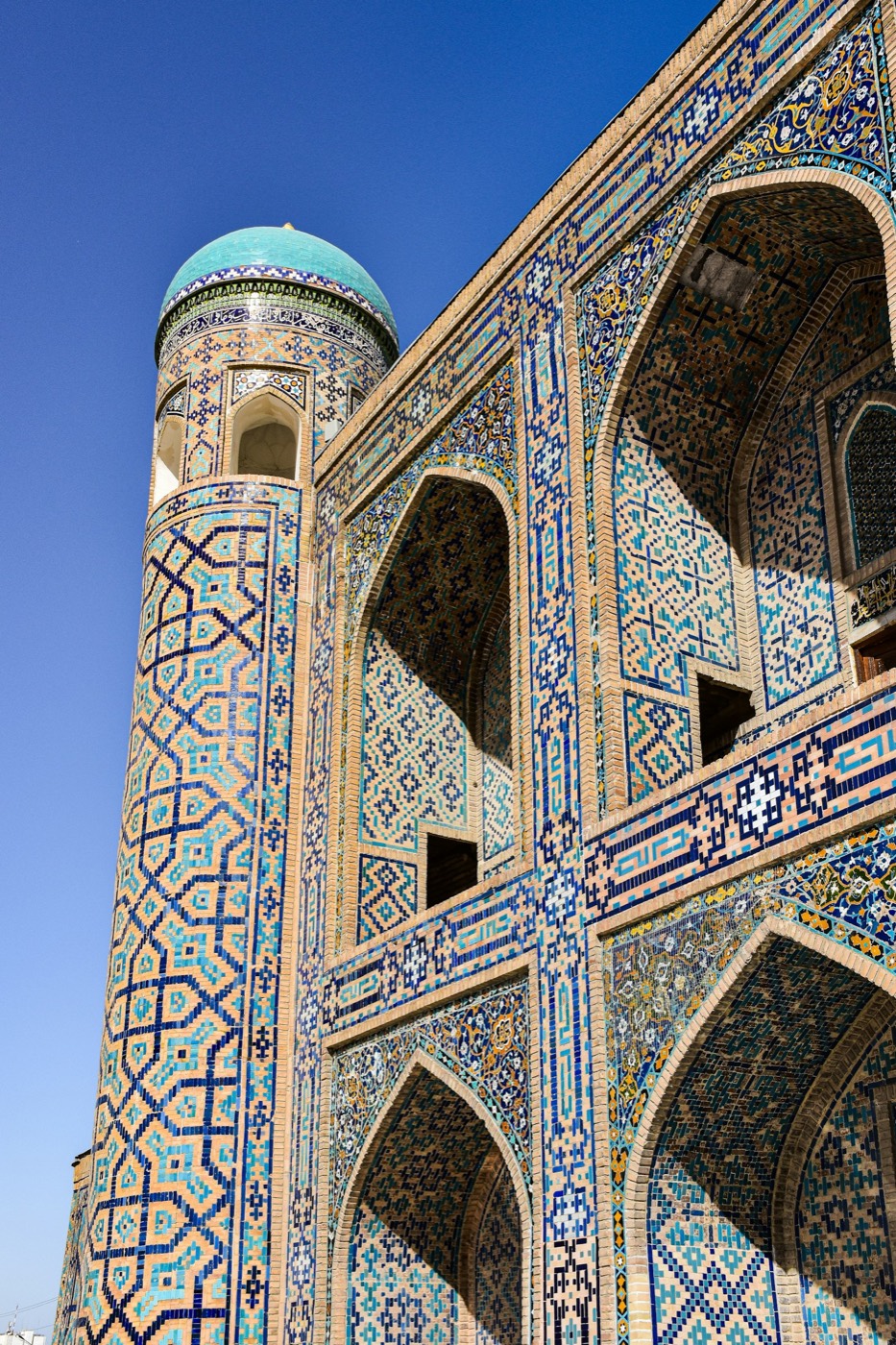
Tilya-Kori Madrasa: corner minaret, turquoise dome, and cascading majolica tile.
Photo: via Unsplash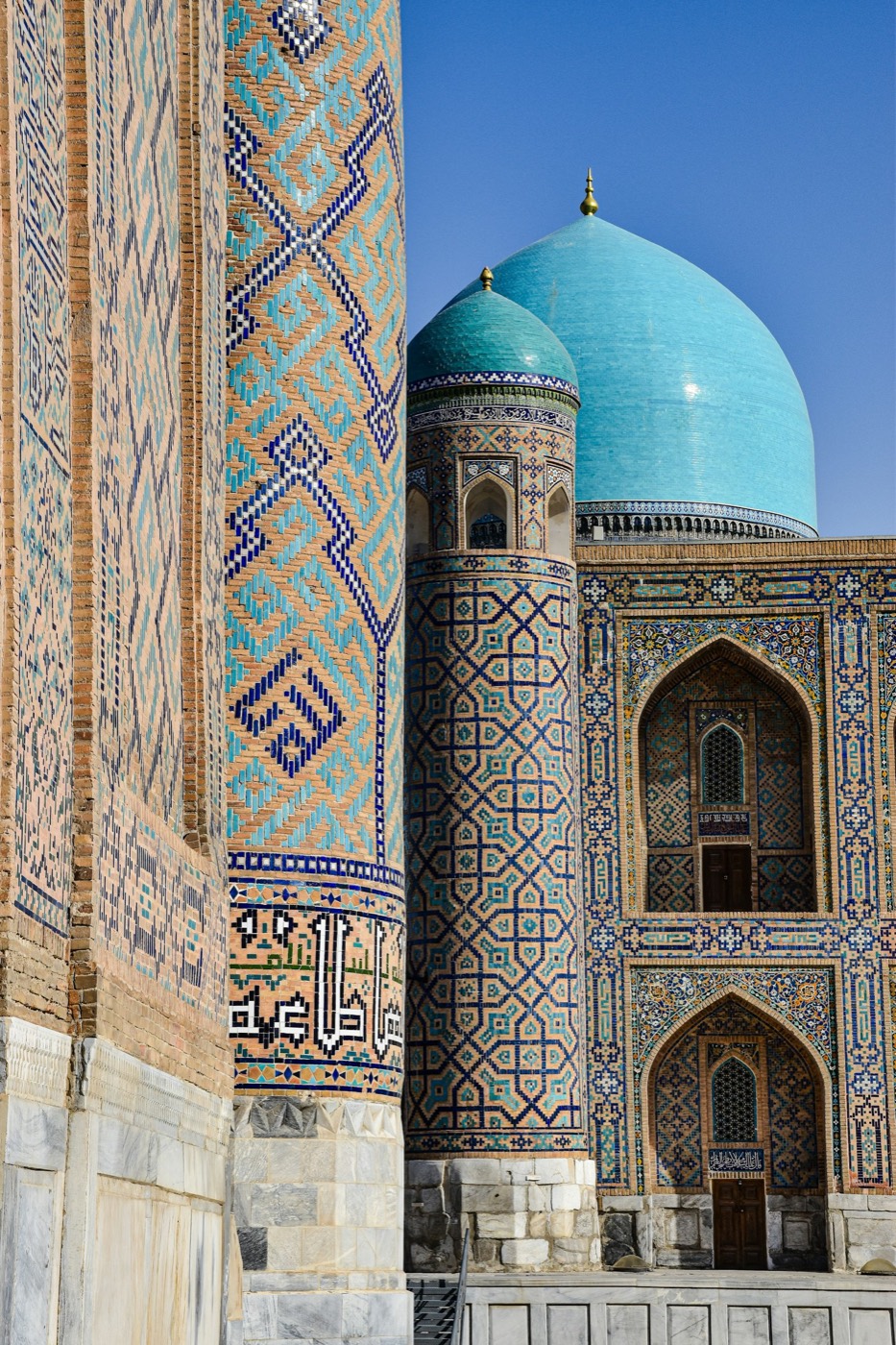
The twin turquoise domes and Kufic-scripted minaret of Tilya-Kori.
Photo: via Unsplash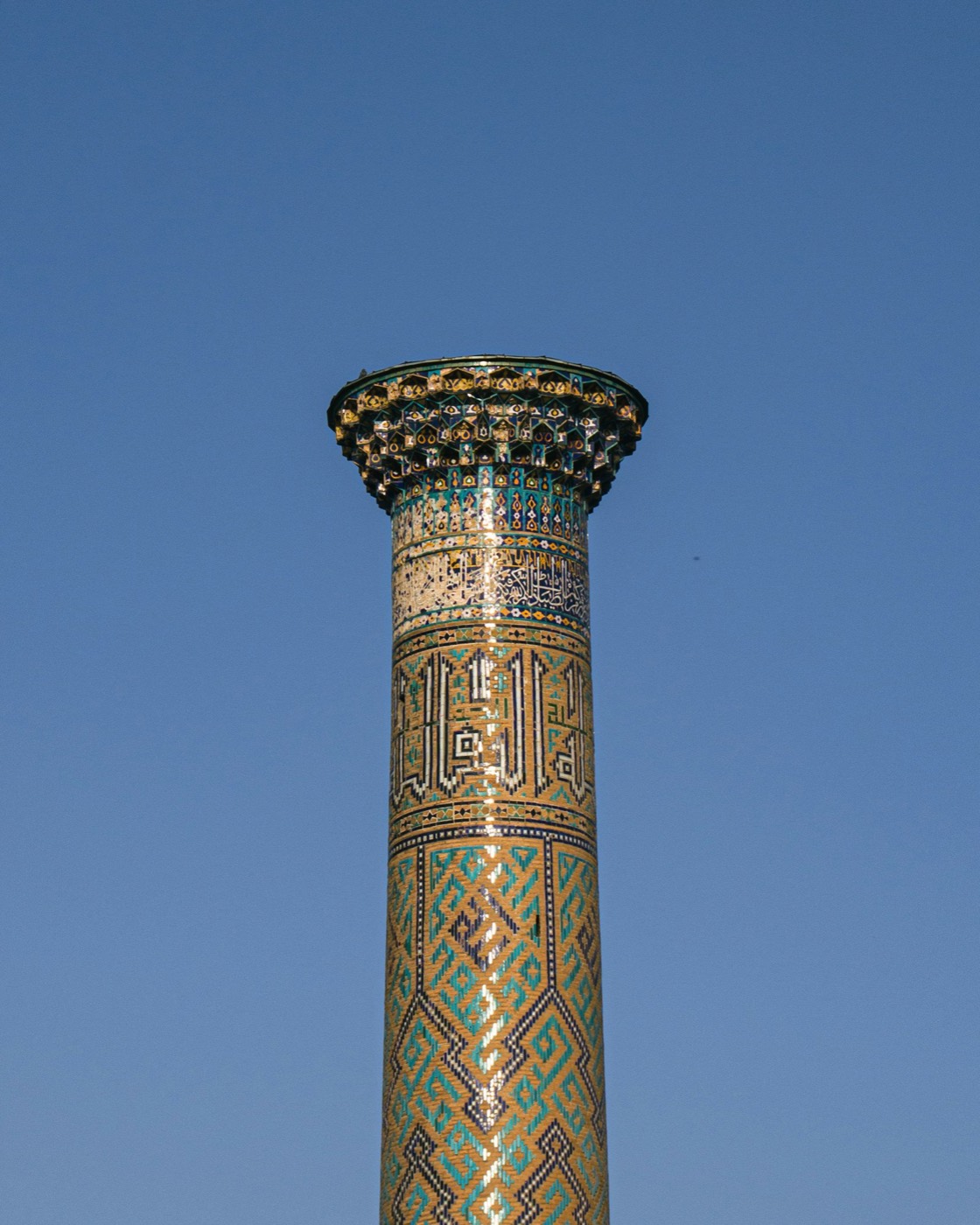
A Registan minaret's crown: muqarnas capital, calligraphy band, geometric brick shaft.
Photo: via UnsplashShah-i-Zinda: the Necropolis of the Living King
A ten-minute walk north of the Registan, up a slope on the edge of Afrasiyab, is the extraordinary Shah-i-Zinda ensemble — a narrow street of some 20 mausoleums built between the 11th and 19th centuries, though the majority date from the Timurid century (1370–1470)[9]. It is arguably the single greatest concentration of Timurid tile mosaic in existence.
The name means 'Living King'. It refers to Kusam ibn Abbas, a cousin of the Prophet Muhammad, who according to local tradition preached in Samarkand in the mid-7th century and was martyred there — but who, in the Sufi legend that grew up around him, retreated alive into a cave beneath the mound to await the return of Islam to Central Asia. His shrine at the top of the street has been the ensemble's spiritual anchor for a thousand years, and the surrounding mausoleums grew up around it because burial near a saint was believed to speed the soul's journey.
The ceremonial staircase up to the ensemble is called the 'Staircase of Sinners': tradition holds that if you count the steps on the way up and on the way down and get the same number both times, your sins are forgiven. There are 36 steps. Miscounting is expected.
The tomb portals along the street — especially the Shodi Mulk Aka (1372, one of the earliest), the Emirzadeh (1386), and the Amir Burunduk mausoleum (early 15th c.) — are the reason architectural historians treat Shah-i-Zinda as a research site in itself. The turquoise-white-blue palette, the calligraphic tile mosaic, and the intricately-tiled muqarnas half-domes over each portal define what the world thinks of as Timurid style[9].
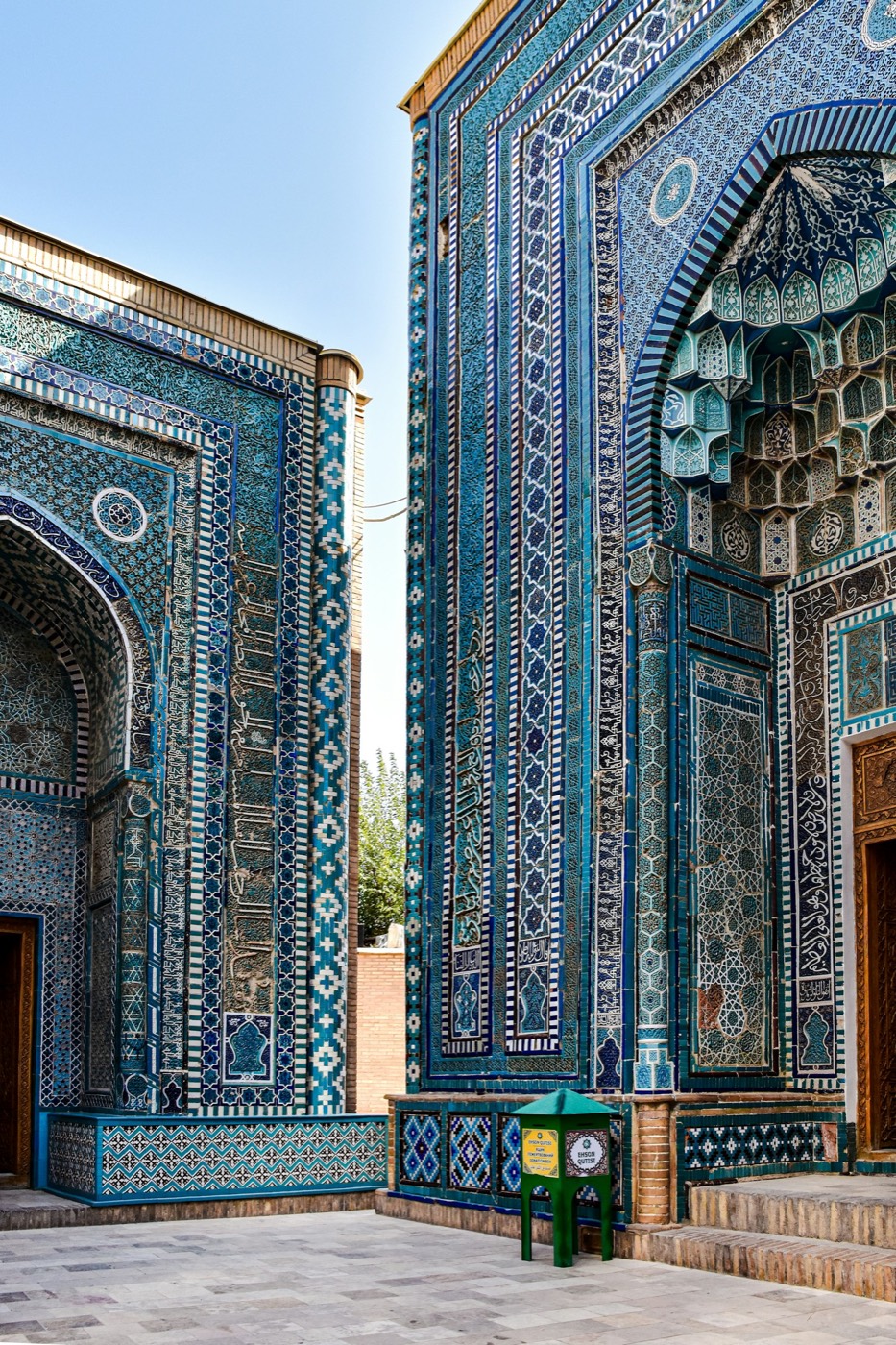
The main street of Shah-i-Zinda — twin portals face each other along the alley.
Photo: via Unsplash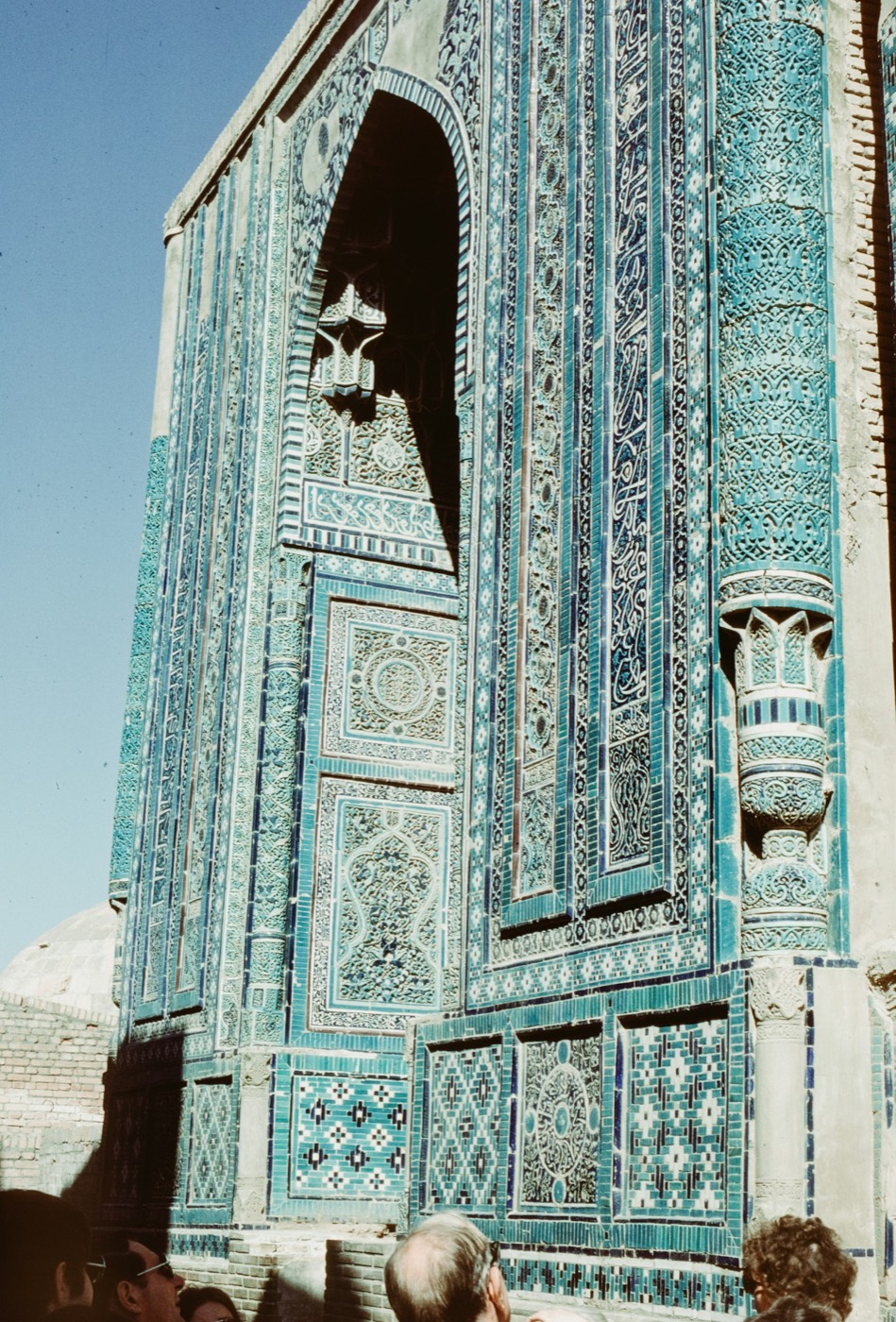
14th-century turquoise tile mosaic on a Shah-i-Zinda mausoleum wall.
Photo: via Unsplash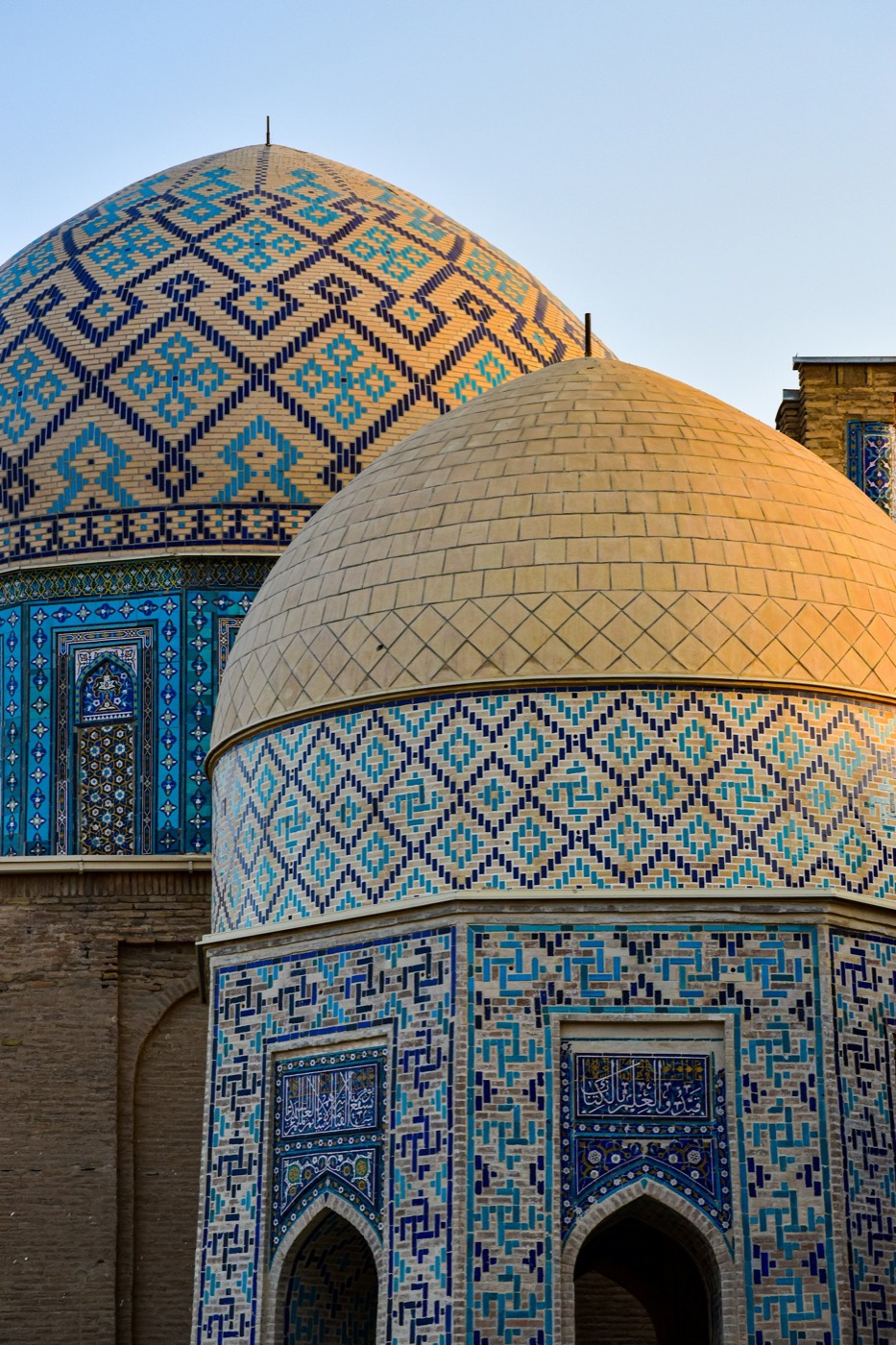
Two Shah-i-Zinda tomb domes — geometric brick + tile mosaic on the drums.
Photo: via Unsplash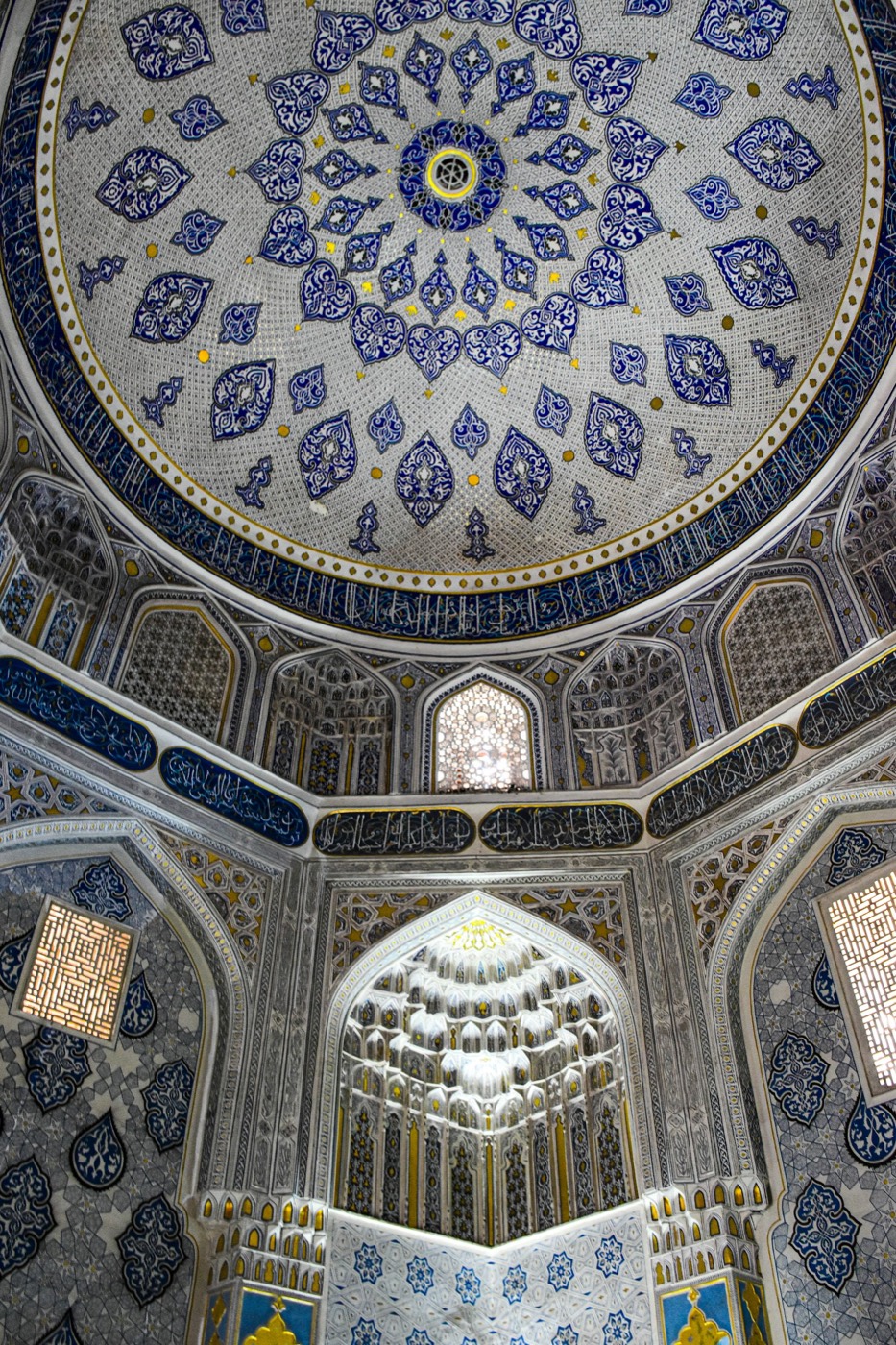
Inside a Samarkand mausoleum dome — arabesques, gold, muqarnas transitions.
Photo: via UnsplashGur-e-Amir: the tomb of Timur
The Gur-e-Amir ('Tomb of the King' in Persian) is a compact octagonal mausoleum a kilometre south of the Registan[11]. Timur commissioned it in 1403 for his beloved grandson and heir-designate Muhammad Sultan, who had died on campaign in Anatolia. When Timur himself died in February 1405 during his march on China, he was buried here rather than in the modest tomb he had prepared for himself in his birthplace, Shakhrisabz.
The tomb contains, in a single crypt beneath its floor, Timur, his sons Shah Rukh (father of Ulugh Beg) and Miran Shah, his grandson Muhammad Sultan, and — most consequentially for astronomy — his grandson Ulugh Beg himself, killed on the orders of his own son 'Abd al-Latif in 1449[5]. The famous nephrite tombstone atop Timur's cenotaph is the largest single piece of jade in the world.
The exterior dome — a fluted, 64-ribbed melon-shape covered in bright turquoise tile — is one of the most-copied architectural profiles in world history. Timur's descendants, the Mughals, brought its silhouette to India: the Taj Mahal (1632–1653) is the most famous later Timurid dome anywhere.
In 1941 the Soviet anthropologist Mikhail Gerasimov opened the coffins to reconstruct Timur's face for a scientific paper. Local elders warned him against it, citing an inscription that reportedly threatened war on whoever disturbed the tomb. The date of the opening — 19 June 1941 — is well-attested. Three days later, on 22 June 1941, Nazi Germany invaded the USSR. Gerasimov reburied Timur with full Islamic rites in November 1942, days before the Soviet turnaround at Stalingrad. The chronology is coincidence, not causation. It is also very hard to forget.
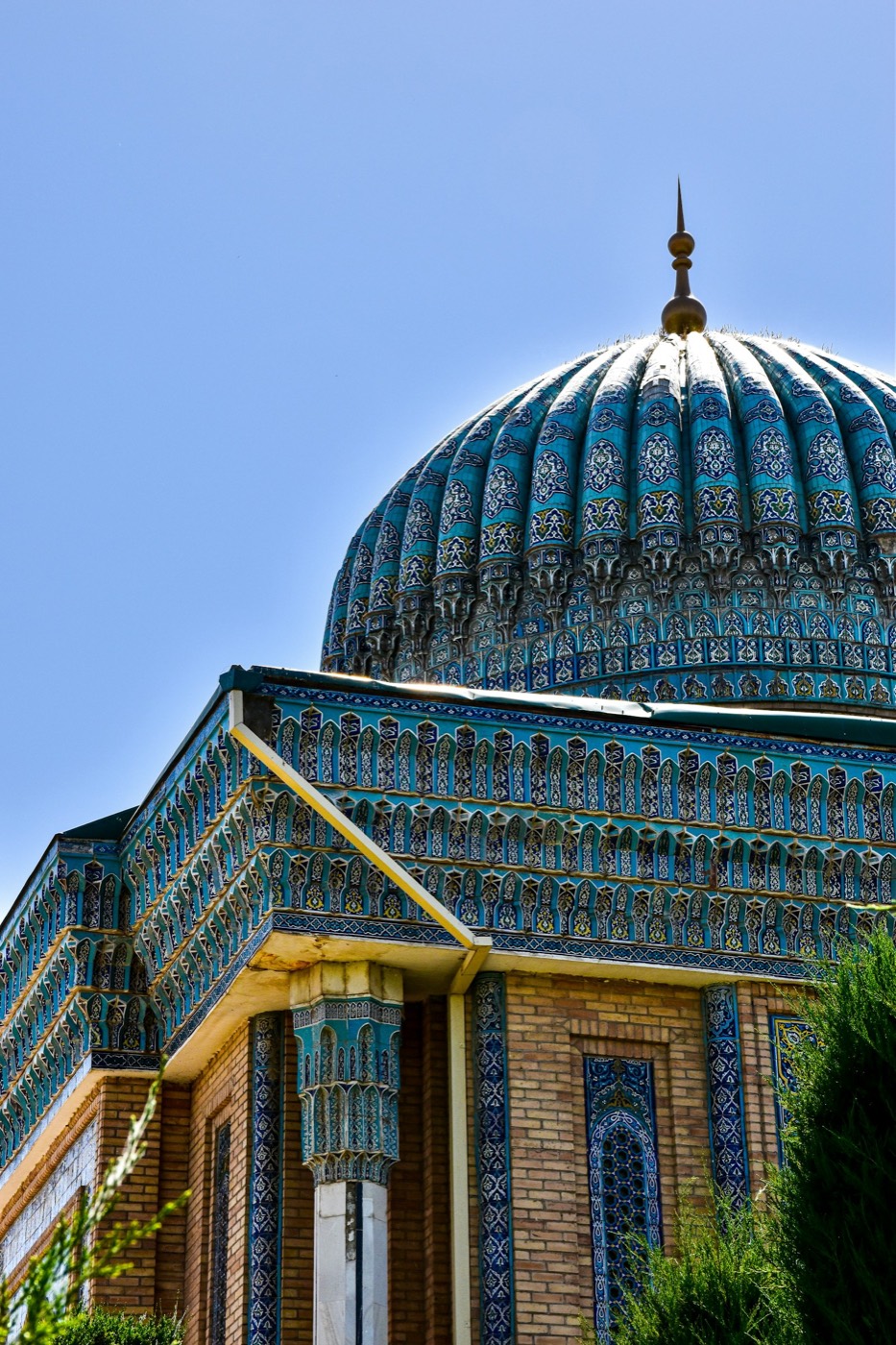
A 64-ribbed melon-dome in the Timurid style — the profile Timur's grandsons would later carry to Mughal India and the Taj Mahal.
Ulugh Beg's observatory: astronomy at 15th-century precision
In 1424–1429, on Kuhak hill just north of Samarkand, Timur's grandson Ulugh Beg built one of the most sophisticated astronomical observatories anywhere in the pre-telescopic world[5]. It was a three-storey brick structure over 30 metres tall, containing at its heart an underground Fakhri sextant with a radius of forty metres — the largest such instrument ever built. Its arc was inlaid with marble tiles engraved with degrees, minutes, and seconds; measurements were made by observing the sun's meridian transit through a hole in the roof.
The observatory produced the Zij-i-Sultani star catalogue (completed 1437), which mapped 1,018 stars with unprecedented precision. Ulugh Beg's measurement of the tropical year was 365 days 5 hours 49 minutes 15 seconds — off from the modern value by less than 25 seconds[5]. His observations were the most precise made anywhere in the world until Tycho Brahe's Danish work 150 years later.
Ulugh Beg himself was murdered by his own son 'Abd al-Latif in 1449. The observatory, associated in some clerical minds with impious inquiry, was destroyed by a mob shortly afterwards, and its site forgotten. It was only rediscovered in 1908, by the Russian archaeologist Vasily Vyatkin, who found the underground sextant still intact beneath a Samarkand hillside. It is now one of the most moving small sites in Central Asia — a stone arc, running down into the earth, with faded degree markings still legible on its rail.
Bibi-Khanym and the Siyob bazaar
North-east of the Registan, on a plaza that fronts Samarkand's main Siyob bazaar, is the Bibi-Khanym mosque (1399–1404) — the largest congregational mosque of its time in the Islamic world[10]. Timur commissioned it after his victorious campaign in Delhi, and — as with all his major projects — imported architects and craftsmen from every conquered city. The main dome was over 40 metres high; the courtyard held 10,000 worshippers.
The building was structurally over-ambitious. Cracks appeared within decades of completion; a 19th-century earthquake reduced parts of it to ruin. Soviet restoration in the 1970s and Uzbek work since 2001 have re-erected the main iwan and dome, though the interior remains a partial ruin. The atmosphere is arresting precisely for that reason — Timurid gigantism at the moment of collapse and recovery.
The Siyob bazaar next door is the working market of Samarkand and has been for at least six centuries. This is where you buy the city's famously-heavy round non bread (stamped with a distinct Samarkand pattern), Samarkand's dried melons and apricots, and the sweet chak-chak and halva that fill the sweet stalls. Bring cash and small notes.
Everyday Samarkand: the bazaar, the plov, and the wine
Away from the monuments, Samarkand is a working city of about 550,000 people, with one of Uzbekistan's most diverse populations. Officially the population is Uzbek, but the older neighbourhoods around the Registan and Siyob bazaar are heavily Tajik at family-language level — as much as 60 per cent by unofficial estimates. Both Uzbek and Tajik are used interchangeably on the street; you'll hear both within the same conversation among older residents.
Samarkand plov is served differently from Tashkent plov: rice, meat, and carrots are arranged in visual layers on the plate rather than mixed, and lamb tail-fat is the near-universal cooking fat. The best serious plov spot in town is the Samarkand branch of the Central Plov Center, though local families will tell you the plov that mattered was made by their grandmother. Both statements are true.
Central Asia's oldest working winery is the Khovrenko winery, established in 1867 during the Russian imperial period. Its cellars — which include a tasting salon in a restored 19th-century vault — offer serious flights of Samarkand-grown pinot, saperavi, and the local Bayan-Shirey grape. The best table wine in Central Asia is arguably made here.
And on the outskirts of the city, the Konigil village still produces silk-fibre paper by the Samanid-era method that once supplied the entire Islamic world[21]. A short taxi ride away, watermills grind the mulberry bark and Uzbek craftsmen dip the frames the way their 8th-century predecessors did. The paper is now used for restoration work on the very manuscripts it originally carried.
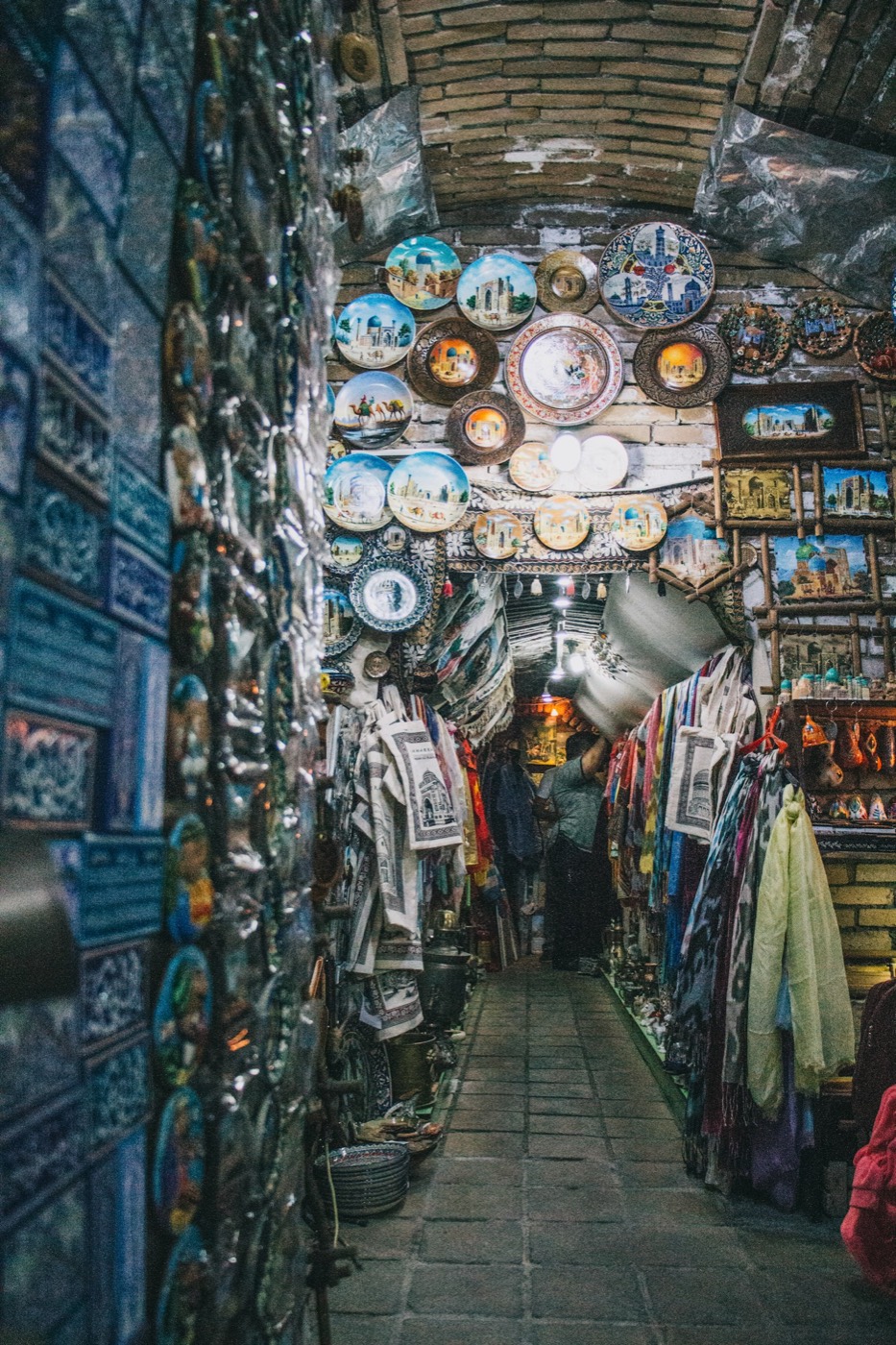
Inside Samarkand's craft bazaar — hand-painted plates of the Registan, ikat scarves from Margilan, and framed monument photography.
Places to visit beyond the headline monuments
The Registan, Shah-i-Zinda, Gur-e-Amir, and Bibi-Khanym are Samarkand's headline monuments — but the city has at least a dozen more sites on the standard visitor circuit that packaged tours routinely skip. A working inventory of the second tier: every one is within a 30-minute drive of the Registan and worth an hour of your day.
Oldest mosque
Hazrat Khizr — Samarkand's oldest sacred site
Built where the first Muslim missionaries entered Samarkand in the 8th century and rebuilt many times (the current fabric is 19th-century). Sits on the ridge overlooking Afrasiyab and Shah-i-Zinda — a superb sunset viewpoint. Free.
Modern Timurid
Islam Karimov Mausoleum — a mother-of-pearl mihrab
Built in 2016 for Uzbekistan's first president (d. Sept 2016). Timurid-revival architecture, 17.4-metre turquoise dome, mother-of-pearl mihrab, marble courtyard. Adjacent to Hazrat Khizr. Free.
Timurid tomb
Rukhabad Mausoleum (1380) — Timur's oldest survivor
Rukhabad ('Abode of the Spirit'), 100 m north of Gur-e-Amir, was built in 1380 for the Sufi sheikh Burhan al-Din Sagardzhi and reportedly holds seven strands of the Prophet's hair. Timur is said to have dismounted every time he rode past. Free entry.
Bibi-Khanym Mausoleum
The tomb of Timur's chief wife, across the plaza
Directly across the plaza from the massive Bibi-Khanym mosque is the smaller, more intimate Bibi-Khanym Mausoleum where Timur's chief wife Saray Mulk Khanum and other Timurid royal women were buried. Restored in the 1990s.[10]
Hidden Timurid
Ak-Saray Mausoleum — the tomb almost no one visits
A small 15th-century mausoleum for members of Timur's family, tucked 200 m south-west of Gur-e-Amir. Turquoise tile mosaic in miniature — a preview of the great tombs at a fraction of the crowd. Small entry fee.
Interfaith shrine
Khodja Doniyor — the 18-metre tomb of Daniel
On a hillside north-east of the old city, this shrine holds what Muslim, Jewish, and Christian pilgrims all believe to be the tomb of the prophet Daniel — reportedly brought here by Timur from Susa. The cenotaph is 18 metres long; a pistachio tree beside it flowered again in 1996 after 500 years dormant.
Hilltop shrine
Chupan-Ata — the shepherd-saint's viewpoint
On a hill 3 km north of the city, this small 15th-century mausoleum commemorates a Sufi shepherd-saint. The path up passes family graves and reaches the best all-Samarkand viewpoint in the city. Best at sunset.
Modern
Silk Road Samarkand — the 260-hectare Eternal City
Built in 2022 for the SCO summit at a reported cost of $500 million. The compound includes eight hotels, a conference centre, and 'Eternal City' — a full-scale reconstruction of a medieval Silk Road town with restaurants, artisan workshops, and evening light shows on the eastern edge of Samarkand.[23]
Living heritage
Konigil Paper Mill — the Samanid method still working
12 km east of Samarkand, the Meros mill at Konigil is the last workshop in the world still making mulberry-fibre paper by the 8th-century Samarkand method. A water-wheel grinds the bark; the sheets are hand-dipped. The paper is now used for restoration work worldwide.[21]
Downtown
Amir Temur Park & the old bazaar domes
The park between the Registan and University Boulevard has the statue of Amir Temur (1996), the 15th-century Chorsu trading dome (Samarkand's oldest surviving covered bazaar structure), and the entrance to the old town's dining spine. A useful orientation point.
Museums worth your time
Samarkand's museums are under-visited. The Afrasiyab holds one of the great surviving Silk Road paintings; the Ulugh Beg observatory museum tells the story of medieval Central Asian astronomy on the exact spot where it happened; and a handful of specialist museums round out what the monuments alone cannot show. All six below are within 15 minutes' taxi of the Registan.
Sogdian art
Afrasiyab Museum — the Ambassadors' Fresco (c. 660 CE)
The centrepiece is a mid-7th-century wall painting from the palace of a Samarkand ruler showing envoys from Tang China, Korea, Persia, and India converging on the Sogdian court. It is the single most important surviving Sogdian painting and one of the great Silk Road documents. The museum also holds Bronze Age pottery, Achaemenid coins, and medieval Islamic ceramics from the Afrasiyab site.[3]
Astronomy
Ulugh Beg Observatory Museum — the 40-metre sextant
Adjacent to the actual observatory ruin — the marble arc of the Fakhri sextant, running down into the earth on Kuhak hill — the museum documents the Zij-i-Sultani star catalogue, Ulugh Beg's team of astronomers, and the 1908 rediscovery by the Russian archaeologist Vasily Vyatkin. Small but essential.[5]
Regional history
Samarkand State Museum of Culture and Art
Housed in a 19th-century Russian merchant's mansion on Sovetskaya. Covers Samarkand's history from prehistoric Sogdian settlements through the Timurid period to the Russian colonial and Soviet eras, with ethnographic displays including a full 19th-century Uzbek household set-up. Under-visited relative to its quality.
Living crafts
Meros Paper Mill Museum (Konigil village)
The Meros mill at Konigil functions as both a working papermaking studio and a museum of the Samanid-era craft. Watch craftsmen strip mulberry bark, boil the fibres, dip the frames, and press the sheets by the 8th-century method. The gift shop sells the paper by the sheet in various weights.[21]
Literature
Sadriddin Ayni House Museum
Sadriddin Ayni (1878–1954), the founder of modern Tajik literature, lived much of his life in Samarkand. His house near the Registan is preserved with manuscripts, first editions, and his personal library. A quiet 30-minute stop for anyone interested in Central Asian literature. Free.
Contemporary
Silk Road Museum (Silk Road Samarkand complex)
Opened alongside the 2022 SCO summit facility, this modern museum uses interactive displays and reconstructions to tell the Silk Road story from Han China to Byzantine Rome — with Samarkand-specific artefacts throughout. Air-conditioned and comfortable in July; a good afternoon in high summer.[23]
Experiences: things to do, not just see
Beyond the monuments, Samarkand has become a serious hands-on-experience destination. Cooking classes, workshops in millennium-old crafts, wine tastings, biennial music festivals, and day-trips into the wider Timurid heartland — the more time you have, the deeper the city goes. Ten of the best, most book-worthy experiences on offer:
Nightly, summer
Registan sound-and-light show
Every summer evening (April–October) around 21:00, a 30-minute son-et-lumière is projected onto the madrasa facades — a history of Samarkand narrated in Uzbek, Russian, and English. Free from the main square; better sightlines from the balcony of the visitor centre.
Cuisine
Plov cooking class with a local family
Family cooking schools (search 'Damas Cooking Class' or 'Ilhom Cooking Studio') run 3-hour sessions: shopping in Siyob bazaar for ingredients, cooking Samarkand-style layer plov in a family courtyard, then sitting down to eat it. ~$40 per person including the bazaar tour.
Drinks
Khovrenko winery tasting (est. 1867)
The oldest winery in Central Asia, in continuous production since 1867. Cellar tours (~$15) include a flight of 8–10 Samarkand-grown wines: pinot, saperavi, muscat, and the local Bayan-Shirey grape. Book ahead — English-guided tours run once a day.
Craft
Silk carpet demonstration at Hujum
The Hujum silk carpet factory (on the road to Ulugh Beg's observatory) demonstrates the full silk-to-carpet process: silkworm breeding, cocoon boiling, hand-reeling, natural dyeing (pomegranate, walnut, indigo), and knotting. A single 1 m² carpet takes one weaver three months. Free entry; retail attached.
Craft
Dip your own sheet at Konigil paper mill
Meros mill at Konigil village offers a hands-on workshop where you dip a sheet of mulberry-fibre paper by the 8th-century Samarkand method. Takes 45 minutes; the sheet dries in a day and can be collected or posted. ~$15 per person.[21]
Biennial · August
Sharq Taronalari music festival
Every two years in late August, the Registan hosts 'Sharq Taronalari' ('Melodies of the East') — a UNESCO-recognised folk-music festival with 60+ countries participating. The Registan is transformed into a nightly open-air concert hall. Next edition: August 2027.[24]
Day trip
Shakhrisabz — Timur's birthplace
90 km south of Samarkand across the Takhta-Karacha pass, Shakhrisabz is where Timur was born in 1336. Its UNESCO-listed historic core preserves the two 38-metre towers of his Ak-Saray palace gate — all that survives of what was designed to be the largest palace in the world. Full-day taxi ~$60.
Photography
Registan at the blue hour
About 30 minutes after sunset, the sky reaches its deepest cobalt while the Registan floodlights are already at full brightness. Every canonical travel photograph of Samarkand comes from this 20-minute window. Bring a tripod; the visitor centre stays open until 22:00.
Shopping
Ikat silk in the Registan approach shops
Real Uzbek ikat — hand-woven, naturally-dyed silk cloth — is sold in the smaller shops along the Registan approach and inside Siyob bazaar. A full 6-metre length starts at ~$80; a factory imitation is $15. The difference is visible under a loupe (real ikat has slightly bleeding pattern edges).
Outdoor
Bicycle tour of Afrasiyab
Several operators offer guided 2-hour bicycle tours across the Afrasiyab archaeological reserve — the pre-Mongol city site north of modern Samarkand. Rolling terrain, occasional pause at excavated palaces. ~$25 including bike and guide. Best in April–May.[3]
How to visit Samarkand: itinerary, train, best months
Samarkand is easy to reach and easy to walk. Almost every visitor arrives from Tashkent on the Afrosiyob high-speed train — 3 daily services, 2 h 10 min for the 308 km, about US $25 in second class and US $40 in first (2024 fares)[22]. Book on the state railway app 'UZBR' or on chipta.uz 1–2 weeks in advance in the busy season. From Bukhara the Afrosiyob is 1 h 30 min. Domestic flights (Uzbekistan Airways) also serve Samarkand International Airport (SKD).
Three nights is a workable minimum; four is more comfortable. Day 1: Registan (allow half a day), then Bibi-Khanym and Siyob bazaar. Day 2: Shah-i-Zinda (best light at 9–10 am), Gur-e-Amir (small, allow 45 min), and Ulugh Beg's observatory (10 minutes by taxi north). Day 3: Afrasiyab archaeological site and museum (Ambassadors' Fresco), then the Konigil paper mill, and dinner at Khovrenko or one of the newer restaurants along the Old City spine.
The best months are April–May (spring blossom and 18–24 °C days) and September–October (harvest, 22–28 °C, longer light). Midsummer is 35–40 °C; the winter (December–February) is 0–8 °C, with occasional snow on the monuments — a superb photograph if you can time it. All main sights are within a 3-kilometre radius of the Registan and easily walkable; taxis are cheap.
Tips and tricks
Buy the Registan ticket at the west gate
The west entrance (nearest the Registan Hotel side) has shorter queues than the main visitor centre gate. The combined ticket (~40,000 UZS / $3) covers all three madrasas.
Photograph Shah-i-Zinda at 9 am
Morning light hits the west face of the tomb portals — the tile colours are at their most saturated. By 11 am tour groups fill the alley; the queue is much shorter early.
Do not miss Tilya-Kori's gilded prayer hall
Most tourists tick the Registan courtyard and leave. The gold-leaf interior of Tilya-Kori's prayer hall is the single most extravagant room in Central Asian architecture — a ten-minute detour behind the north iwan.
Take the Afrosiyob train, not the slower Sharq
The Afrosiyob does Tashkent–Samarkand in 2 h 10 min at 250 km/h. The slower Sharq takes 3 h 30 min for a similar fare. Book on chipta.uz or the UZBR app; second class is fine and cheaper than a taxi.
Samarkand plov is different — order it here
Rice and meat arranged in visual layers on the plate rather than stirred, lamb tail-fat as the only cooking fat. The Samarkand branch of Central Plov Center serves the definitive version; ordering starts at noon and stops when it runs out (usually 3 pm).
Save half a day for the Afrasiyab museum
The Ambassadors' Fresco — a 7th-century Sogdian mural of Chinese, Korean, Persian, and Indian envoys at the court of Samarkand — is one of the most important surviving Silk Road paintings anywhere. The museum is 15 minutes' walk north of Shah-i-Zinda.
Frequently asked questions
How many days do I need in Samarkand?
Three nights (two full days plus arrival/departure days) is a workable minimum. Four nights lets you cover Afrasiyab, the Konigil paper mill, and a Khovrenko winery tasting without rushing. Serious history buffs stay a week.
Samarkand or Bukhara — which is better?
Different characters. Samarkand is the Timurid imperial capital — theatrical, high-drama monuments (Registan, Bibi-Khanym, Gur-e-Amir), all rebuilt from scratch after 1370. Bukhara is a fully-preserved 2,500-year-old Silk Road oasis city — more human-scale, more medieval-feeling, 140+ protected monuments in a compact old town. Most trips do both, connected by the Afrosiyob in 1 h 30 min.
When is the best time to visit Samarkand?
April–May and September–October. Spring has blossom on the almond and pomegranate trees; autumn has the mulberry-and-pomegranate harvest and softer light on the tilework. Both windows have 18–28 °C days and cool nights. Midsummer is 35–40 °C, winter is 0–8 °C with occasional snow.
How do I get from Tashkent to Samarkand?
The Afrosiyob high-speed train — 3 daily services, 2 h 10 min, ~$25 in second class. Book on the state railway app UZBR or on chipta.uz 1–2 weeks in advance in the busy season. There are also domestic flights on Uzbekistan Airways (1 h) and long-distance shared taxis (4 h).
Is Samarkand walkable?
The old-city core is very walkable — all main sights (Registan, Bibi-Khanym, Shah-i-Zinda, Gur-e-Amir, Siyob bazaar) sit within a 3-kilometre radius. The Ulugh Beg observatory, Afrasiyab museum, and Konigil are 10–20 minute taxi rides. Taxis are cheap; walking distances are honest.
Can I visit the Registan at night?
Yes — the exterior stays open and floodlit until about 22:00, and it is the single best photographic hour in the city. On summer evenings there is often an audio-visual son-et-lumière show projected onto the madrasa facades (check the schedule at the visitor centre).
Where exactly is Timur buried?
In a single crypt beneath the floor of the Gur-e-Amir mausoleum, together with his sons Shah Rukh and Miran Shah, his grandson Muhammad Sultan (for whom the tomb was originally built), and his grandson Ulugh Beg. The cenotaph above ground is a symbolic marker; the actual burials are one level below. Excavations of the crypt in 1941 confirmed both the family relationships and Timur's characteristic limp.
Do I need a photography permit at the monuments?
Most sites include still-camera photography in the entrance ticket. Some (notably the interior of Tilya-Kori and some Shah-i-Zinda mausoleums) charge a small additional fee for photography, typically 20,000–30,000 UZS (~$2). Tripods and video usually require a separate permit; ask at the ticket kiosk.
See also
References
Every article on this site cites primary and secondary sources. Inline superscripts [n] link to the numbered entries below. All external links open in a new window.
- Samarkand – Crossroad of Cultures (World Heritage inscription)— UNESCO (2001)
- Samarkand — city profile— Britannica
- Afrāsīāb i — Excavations of the Pre-Mongol City— Encyclopædia Iranica
- Samarkand — historical geography— Encyclopædia Iranica
- Ulugh Beg's Observatory (Samarkand)— Britannica
- Timur (Tamerlane) — biography— Britannica
- Alexander the Great — biography and campaigns— Britannica
- Registan (three madrasas of Samarkand)— Wikipedia
- Shah-i-Zinda necropolis— Wikipedia
- Bibi-Khanym mosque— Wikipedia
- Gur-e Amir mausoleum— Wikipedia
- Battle of Talas (751 CE) — and the paper transfer— Britannica
- Samanid dynasty (819–999)— Britannica
- Arrian, Anabasis of Alexander (Book IV — Sogdian campaign)— Perseus Digital Library
- Russia in Central Asia in 1889 (Curzon on the Registan)— George Curzon (1889)
- Genghis Khan — Mongol siege of Samarkand (1220)— Britannica
- Afrasiyab (archaeological site)— Wikipedia
- Al-Biruni — biography— Britannica
- Uzbekistan — country overview and tourism— Uzbekistan Ministry of Tourism
- Ibn Sina (Avicenna) — biography— Britannica
- Konigil paper mill (Samarkand)— Advantour
- Afrosiyob (Uzbekistan high-speed train)— Wikipedia
- Silk Road Samarkand tourism complex (2022 SCO summit venue)— Wikipedia (2022)
- Sharq Taronalari International Music Festival, Samarkand— UNESCO Silk Roads Programme
External links
- UNESCO Samarkand WHS details— UNESCO
- Uzbekistan Railways — Afrosiyob booking— O'zbekiston Temir Yo'llari
- Samarkand State Museum-Reserve— Government of Uzbekistan
Related articles
City deep-dive
Bukhara: history, etymology, and interesting facts
2,500 years old, birthplace of Al-Bukhari and Ibn Sina, home to more than 140 protected monuments, and the most complete architectural ensemble on the Silk Road.
City deep-dive
Khiva: history, etymology, and interesting facts
The walled inner city of Ichan Kala, first UNESCO site in Uzbekistan, and the most complete surviving medieval oasis city on the Silk Road.
History
A short history of Uzbekistan — from Sogdiana to the New Uzbekistan
3,000 years compressed into fifteen minutes: Sogdiana, Alexander, Arab conquest, the Islamic Golden Age, Genghis Khan, Timur, the khanates, the Russians, the Soviets, and today.
Silk Road
The Silk Road in Uzbekistan: how the world's first world market ran through Samarkand
For 1,500 years the greatest overland trade network on Earth ran through what is now Uzbekistan. Its physical, cultural, and religious legacy is still the country's dominant story.
Little-known facts
60 little-known facts about Uzbekistan
The country that gave the world algebra, holds the tomb of Timur, and cooks 12,000 servings of plov a day — and 57 other things travellers rarely arrive knowing.
Language
Languages and writing systems of Uzbekistan
Uzbekistan speaks 15+ living languages and has been written in more than ten scripts over 2,500 years. Uzbek — the world's second-most-spoken Turkic language after Turkish — has cycled through four alphabets in a single century.